
Right-Believing
Oleg of Ryazan
Prince of Ryazan
Prince of Ryazan from 1252 to 1258, called the Red or the Handsome; honored as a local saint.
- Feast
- June 10old style June 23
- Reposed
- 125813th century
Life
Prince Oleg Ingvarevich the Red (or the Handsome, mid-1200s to 20 March 1258) was prince of Ryazan, son of Ingvar Igorevich, according to some sources from 1238 to 1258, according to others only from 1252 to 1258. Our sources call him pious and blessed and say only that he was venerated in Ryazan, from 1258, as a man of the local ruling house; they show no canonization. Our record has no commemoration day.
Life
In the autumn of 1237 Prince Yuri Igorevich of Ryazan, together with Oleg Ingvarevich and his son Roman Ingvarevich, led the resistance to the army of Khan Batu. The chronicles say nothing of Oleg's fate at the end of December 1237. Since at the beginning of January 1238, at Kolomna, only Prince Roman fought against the Mongols, it may be judged that Oleg was then a prisoner of the Mongols, perhaps at the taking of Ryazan on 21 December 1237. The historian A. V. Ekzemplarsky wrote that in the winter of 1237, in the battle at Kolomna, Oleg was taken prisoner, where Batu forced him to change his faith, but he refused and was "spared for his rare beauty".
Sources of the mid-sixteenth to seventeenth centuries state that he was a political hostage in the camps of the Mongol rulers between 1237 and 1252, a view widespread also in current research. But the older chronicles contain no information about so long a stay in Mongol captivity, either of the princes of Ryazan or of other Russian ones; the historian A. V. Kuzmin, on the basis of several chronicles of northern Rus', judged mistaken the claim of a fourteen-year stay and thought that Oleg was freed soon after 1237, and L. V. Vorotyntsev judged the hypothesis of a long "Horde captivity" scientifically unfounded. Except for Oleg, all the older princes of Ryazan died in the battles with the Mongols at the end of December 1237 and the beginning of January 1238, so Oleg was recognized by the Mongols as ruler of Ryazan almost immediately after the devastation of the Russian lands. According to the chronicle of Avraamka he returned to Ryazan in 1243. He was the first of the Russian princes to go to Karakorum and return alive; it is thought that he received there his charter of rule from the widow of the great khan Ögedei, Töregene, ruler of the Mongol Empire. He nevertheless took part in the resistance to the Mongols: in 1250 he was summoned to the Horde and arrested, and was let back to Ryazan in 1252, after his allies had been crushed and he no longer posed danger to the Horde.
His end
In 1258, feeling death approaching, he was tonsured into the great schema. He died on 20 March 1258 and was buried in the church of the Saviour. He was venerated in the principality of Ryazan from 1258 as a representative of the local dynasty, in fact founder of the line of the grand princes of Ryazan, which ended at the end of the first third of the sixteenth century, and of the princes of Pronsk. From the last third of the thirteenth century his commemoration was held chiefly in the Saviour cathedral at Ryazan, and from the second quarter of the fourteenth century in the Dormition cathedral at Pereslavl-Ryazansky. His father, Ingvar Igorevich (died 1235), was prince of Ryazan from 1217; his brothers were Yuri (killed 1237) and Roman (killed 1237), and a sister Eudokia; his son, Roman (1237 to 1270), was grand prince of Ryazan from 1258.
Commemorated the same day June 10
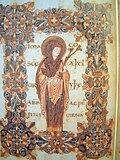 Etheldreda of ElyVenerable · Abbess of ElyJun 10
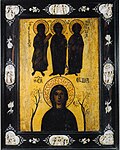 Olivia of PalermoMartyrJun 10
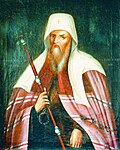 John of TobolskSaint · Metropolitan of TobolskJun 10
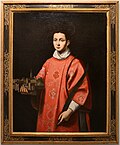 Maximus of AveiaMartyr · Deacon and martyrJun 10
 Basil of RyazanSaint · Bishop of Ryazan and MuromJun 10
 Mitrophan Chi SungHieromartyr · First Chinese Orthodox priestJun 10
 Dosifei of KyivVenerable · Rassophore at the Kiev Caves LavraJun 10
 Philotheus of TobolskSaint · Metropolitan of Siberia and TobolskJun 10
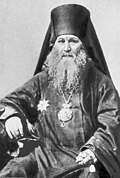 Gerasim DobroserdovSaint · Bishop of AstrakhanJun 10
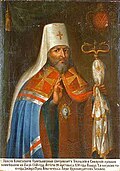 Paul of TobolskSaint · Metropolitan of TobolskJun 10
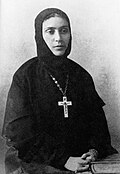 Schema-abbess Tamar MarjanishviliConfessor · Georgian schema-abbessJun 10
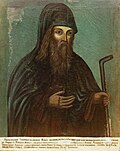 Dalmat of IsetskVenerable · Founder of Dalmatov MonasteryJun 10