
Saint
Ulrich of Augsburg
Bishop of Augsburg
Bishop of Augsburg, a caring shepherd and defender of his city, reposed in 973.
Life
Saint Ulrich of Augsburg was bishop of Augsburg in the tenth century, a caring shepherd of his flock and the defender of his city in the time of the Magyar raids. He reposed on 4 July 973.
Early life
Ulrich was born in 890 at Kyburg, in the present canton of Zürich in Switzerland, to Count Hupald of Dillingen and Dietpirch of Swabia. His parents offered him to the Church while he was still a child, and at seven he was sent to the monastery of Saint Gall, where he proved an excellent pupil. There he became a friend of Wiborada, a recluse living near the monastery, who foretold that he would become a bishop. He resolved to be ordained, but hesitated between monastic life at Saint Gall and service as a secular priest.
Before April 910 he was sent to a kinsman, Adalbero, bishop of Augsburg, who made him his chamberlain. After Adalbero's death Ulrich went home, and the Duke of Swabia presented him at the court of Henry the Fowler.
Bishop
Through the influence of his maternal uncle, Duke Burchard II of Swabia, and other relatives, King Henry appointed him bishop of Augsburg, and he was consecrated on 28 December 923. He labored to raise the moral state of the clergy, renewed the schools, held canonical visitations and synods, cared for the poor, and rebuilt ruined churches and monasteries. He raised churches in honor of Saint Afra and Saint John and founded the convent of Saint Stephen for Benedictine nuns. Twice he went to Rome to obtain relics, in 910 and in 952 or 953. Emperor Otto the Great granted him the right to mint coins.
In the struggle between Otto and his son Liudolf, Duke of Swabia, Ulrich stayed loyal to the king. In the summer of 954, when father and son were about to meet in battle at Illertissen, he and Bishop Hartbert of Chur managed to reconcile them, and on 17 December 954 Liudolf and Conrad of Lorraine begged the king's pardon.
Defender of the city
The Magyars repeatedly raided Bavaria and Swabia. Ulrich built a stone wall around Augsburg and directed the defense of the city. In 955 the Magyars besieged it, and the sources say that, vested in his episcopal robes, the bishop strengthened the defenders with the twenty-third Psalm. The fiercest fighting was probably on 8 August 955 at the eastern gate, where his men beat back the assault. That night he oversaw the repair of the walls. The city held until the emperor arrived, and on 10 August 955 the invaders were defeated at Lechfeld. It is sometimes said that Ulrich fought there himself, but scholars do not consider this well founded.
Repose and veneration
Ulrich was strict with himself and demanded the same of others, and in the imperial diets he remained a firm support of the emperor. At the diet of 20 September 972 he was accused of nepotism, because he had named his nephew Adalbero his coadjutor, on account of his illness and his wish to retire to a Benedictine abbey. He resigned his see and withdrew to Ottobeuren as abbot.
At dawn on 4 July 973 he had ashes spread on the ground in the form of a cross and was laid upon it; when the envoy of Emperor Otto II arrived, he reposed while the clergy chanted the litany. He was buried in the church of Saint Afra, which he had rebuilt, and on the same spot the church of Saints Ulrich and Afra was later raised. Many miracles were wrought at his tomb, and on 4 July 993, only twenty years after his repose, Pope John XV canonized him, the first saint to be canonized by a pope rather than by a local authority. He is a patron of Augsburg together with Saints Afra and Simpert. He is commemorated on 4 July as a saint of the undivided Church, by the New Calendar.
Commemorated the same day July 4
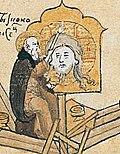 Andrei RublevVenerable · The IconographerJul 4
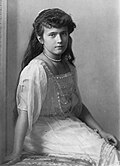 AnastasiaPassion-Bearer · Grand Duchess of RussiaJul 4
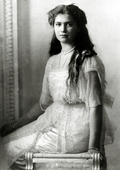 MariaPassion-Bearer · Grand Duchess of RussiaJul 4
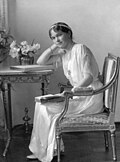 OlgaPassion-Bearer · Grand Duchess of RussiaJul 4
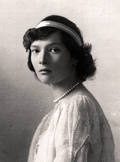 TatianaPassion-Bearer · Grand Duchess of RussiaJul 4
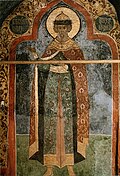 Andrei BogolyubskyRight-Believing · Grand Prince of VladimirJul 4
 Andrew of CreteSaint · Archbishop of CreteJul 4
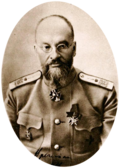 Eugene BotkinPassion-Bearer · Physician of the imperial familyJul 4
 Michael ChoniatesSaint · Metropolitan of AthensJul 4
 Anastasia of KievVenerable · Grand Duchess, later a nunJul 4
 Procopius of SázavaVenerable · Abbot of Sázava MonasteryJul 4
 Sava of Gornji KarlovacHieromartyr · Bishop of Gornji KarlovacJul 4