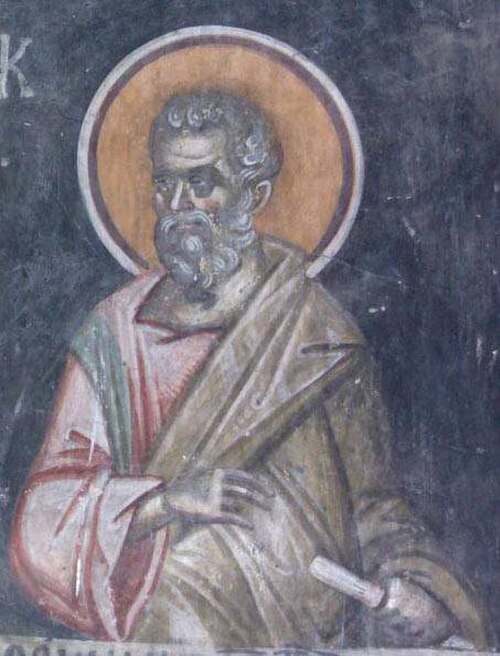
Apostle
Ananias of Damascus
Apostle of the Seventy
Disciple in Damascus who baptized Saul after his vision on the road to Damascus.
Life
The holy Apostle Ananias of Damascus, one of the seventy, was the disciple who healed Saul of blindness and baptized him. He appears in the Acts of the Apostles (9:10-18 and 22:12-16). The Orthodox Church keeps his memory on 1 October and, in the synaxis of the seventy apostles, on 4 January. The Catholic Church remembers him on 25 January.
The healing of Saul
According to Acts, Ananias lived at Damascus. In his speech before the people, Paul describes him as a man devout according to the law, well spoken of by all the Jews who lived there (Acts 22:12). On the road to Damascus Jesus told Saul to go into the city, where he would be told what to do. Saul stayed blind for three days, without eating or drinking, in the house of Judas on the street called Straight.
The Lord spoke to Ananias in a vision and told him to go to Saul of Tarsus and lay his hands on him so that he might see again. Ananias objected that he had heard from many how much harm this man had done to the saints at Jerusalem, and that he had authority from the chief priests to bind all who call on the name of Christ. The Lord answered: "Go, for he is a chosen instrument of mine to carry my name before the Gentiles and kings and the children of Israel. For I will show him how much he must suffer for the sake of my name."
Ananias went, laid his hands on Saul and said: "Brother Saul, the Lord Jesus who appeared to you on the road by which you came has sent me so that you may regain your sight and be filled with the Holy Spirit." Immediately something like scales fell from Saul's eyes and he could see again. He rose and was baptized, then took food and was strengthened. The man who had come to persecute the Church became the Apostle Paul.
According to tradition
The New Testament says no more of Ananias. The synaxarion tells that he was one of the seventy disciples and bishop of Damascus, that he preached boldly there to Jews and Gentiles, and that he then went to Eleutheropolis, where he healed many sick. The local ruler Lucian tried to make him sacrifice to idols, and when Ananias would not, had him tortured and then led outside the city and stoned. He died praying for those who killed him. Azbyka, a Russian Orthodox calendar site, adds that his relics were later taken to Constantinople. Late records of his martyrdom at Damascus also exist, and a tomb is shown beneath the church of Zoravor in Yerevan, Armenia.
At Damascus, on the street called Straight, an underground chapel is shown as the house of Ananias, where Paul is said to have been baptized.
Veneration
The Coptic Church remembers him on 27 Paoni. In the Church he stands as an example of obedience and courage: he went to the man he feared because the Lord commanded it, and through him the Church received the Apostle of the Gentiles.
Commemorated the same day October 1
 Romanos the MelodistVenerable · The HymnographerOct 1
 Mirian III of IberiaEqual-to-the-Apostles · King of IberiaOct 1
 Bavo of GhentVenerable · Missionary in FlandersOct 1
 John KoukouzelesVenerable · Composer and reformer of chantOct 1
 Nana of IberiaEqual-to-the-Apostles · Queen of IberiaOct 1
 Melchizedek I of GeorgiaSaint · Catholicos-Patriarch of GeorgiaOct 1
 Savva of VisheraVenerable · Founder of Savvo-Vishersky MonasteryOct 1
 Gabriel Bănulescu-BodoniSaint · Metropolitan of ChișinăuOct 1
 Michael NovoselovNew Martyr · Publicist and spiritual writerOct 1
- Alexis StavrovskyHieromartyr · PriestOct 1
- SidoniaSaintOct 1
- AbaiMartyrOct 1