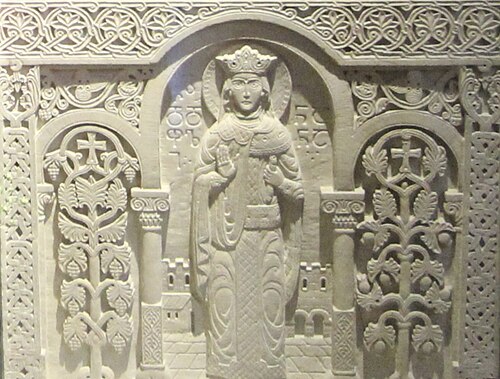
Equal-to-the-Apostles
Nana of Iberia
Queen of Iberia
Queen of Iberia in the fourth century, wife of King Mirian III, honored for her part in the conversion of the Georgians.
- Feast
- October 1old style October 14
- Reposed
- 4004th century
- Place
- Mtskheta
Life
Saint Nana was the queen of Iberia, the second wife of King Mirian III, in the fourth century. For her part in bringing the Georgians to the Christian faith, the Georgian Orthodox Church venerates her as a saint, with the title Saint Queen Nana, Equal to the Apostles. In 2018 her name was also entered in the calendar of the Russian Church.
According to the Georgian chronicles, Nana came “from a Greek land, from Pontus, daughter of Oligotos.” Pontus may here mean the Bosporan Kingdom, then a client state of the Roman Empire. The scholar Cyril Toumanoff assumed that her father's name was a Georgian corruption of “Olympius” or “Olympus,” a ruler of the Bosporus, whose son, Aurelius Valerius Sogus Olympianus, a Roman governor of Theodosia, is known from a Greek inscription of the year 306. Another scholar, Christian Settipani, considers her the younger daughter of King Theothorses of the Bosporus. Mirian married her after the death of his first wife (in 292, according to Toumanoff). Nana bore him two sons, Rev II and Varaz-Bakur, and a daughter, married to Peroz, the first ruler of the Mihranid line in Gugark.
The medieval Georgian sources tell that Nana was a staunch pagan and despised Christian preaching, until she was miraculously cured of a terrible disease by a Christian missionary from Cappadocia, Nino, and then turned to the faith. The Roman scholar Rufinus of Aquileia, who wrote his history fifty years after the conversion of Iberia, from the oral account of Bacurius the Iberian, also speaks of an unnamed queen of the Iberians, cured by a Christian captive woman. Through the ministry of Saint Nino, King Mirian also received the faith around 337, and Christianity became the official religion in Iberia.
Nana outlived her husband by two years and died, according to Toumanoff's chronology, in 363. According to tradition, she and Mirian are buried at the Samtavro convent in Mtskheta, where their tombs are still shown.
Commemorated the same day October 1
 Romanos the MelodistVenerable · The HymnographerOct 1
 Ananias of DamascusApostle · Apostle of the SeventyOct 1
 Mirian III of IberiaEqual-to-the-Apostles · King of IberiaOct 1
 Bavo of GhentVenerable · Missionary in FlandersOct 1
 John KoukouzelesVenerable · Composer and reformer of chantOct 1
 Melchizedek I of GeorgiaSaint · Catholicos-Patriarch of GeorgiaOct 1
 Savva of VisheraVenerable · Founder of Savvo-Vishersky MonasteryOct 1
 Gabriel Bănulescu-BodoniSaint · Metropolitan of ChișinăuOct 1
 Michael NovoselovNew Martyr · Publicist and spiritual writerOct 1
- Alexis StavrovskyHieromartyr · PriestOct 1
- SidoniaSaintOct 1
- AbaiMartyrOct 1