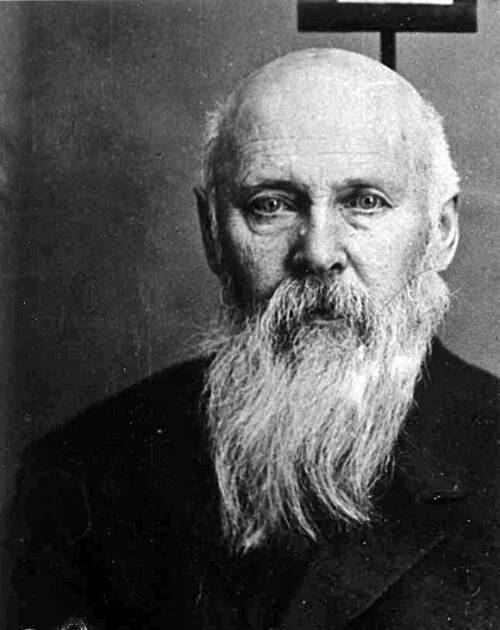
New Martyr
Michael Novoselov
Publicist and spiritual writer
Publicist and spiritual writer, ideologist of the Josephite movement, who died in 1938 in Vologda and was glorified in 2000.
Life
Saint Mikhail Novoselov was a Russian publicist and spiritual writer, a layman, who from a disciple of Tolstoy became a defender of Orthodoxy and, in the years of Soviet persecution, the ideologue of the Josephite movement. Born in 1864 in the village of Babye in the Tver governorate, he was shot at Vologda on 20 January 1938. He was numbered among the New Martyrs and Confessors of Russia in August 2000, as a layman. His friends called him "Abba Mikhail".
Family and Tolstoyan youth
His ancestors were servants of the Church in the Tver diocese. His father, Alexander Grigoryevich Novoselov (1834 to 1887), a graduate of the University of St Petersburg, was director of the classical gymnasium at Tula and then of the fourth in Moscow, and his mother, Kapitolina Mikhailovna, née Zashegrinskaya, was the daughter of the priest of Babye. He graduated from the Fourth Moscow Gymnasium with a gold medal (1882) and from the historical-philological faculty of Moscow University (1886). In youth he was drawn to the ideas of Lev Tolstoy, was an active Tolstoyan and corresponded with him. At the end of 1887 he was arrested for printing Tolstoy's pamphlet "Nikolai Palkin", but in February 1888, through Tolstoy's intercession, he was released under open police supervision, forbidden to live in the capitals. With the inheritance from his father he founded in 1888, in the village of Dugino in the Tver governorate, a Tolstoyan agricultural community, which lasted two years because the intellectuals found physical work hard.
Orthodox before the revolution
In 1892 he changed his views and joined the Orthodox Church. He had contact with Archpriest John of Kronstadt and with the elders of Optina and Zosimova Hermitage and wrote works on church themes, published in the Missionary Review and the Church Gazette. After the decision of the Holy Synod of February 1901, which declared that Tolstoy had fallen away from the Church, and after Tolstoy's very aggressive reply of 4 April, Novoselov wrote him an open letter, on 29 May 1901, saying that he wished to serve not the Lord, whom universal Christianity knows and recognizes, but some unknown impersonal principle, so alien to the human soul that it cannot take refuge in it either in sorrow or in joy.
He took part in the Religious-Philosophical Assemblies of 1901 to 1903. Between 1902 and 1917 he was editor of the "Religious-Philosophical Library", in which many Russian Orthodox thinkers were published; many books in the series were written by him or with his help. The series appeared first at Vyshny Volochyok, then at Moscow and Sergiev Posad, with 39 numbers, about twenty unnumbered books and over eighty "Leaflets", with works of the holy fathers and religious thoughts of great Russian writers and scholars. In 1905 he opposed the hasty election of a patriarch and called for a council, prepared by a consultation of a few bishops, clergy and laity. From 1905 to 1918 he took part in the Moscow Religious-Philosophical Society in memory of Vladimir Solovyov.
In 1907 he founded in Moscow the "Circle of Those Seeking Christian Enlightenment", which met at his apartment, in the so-called "Novoselov Thursdays", with the priests Pavel Florensky and Iosif Fudel, Fyodor Samarin, V. A. Kozhevnikov, S. N. Bulgakov and others. As V. V. Rozanov wrote, the bond of the circle was personal and moral; he was called "Abba Mikhail", though some members far surpassed him in learning, for his clear and kind character and the purity of his soul and intentions. He spoke sharply against Rasputin and published the pamphlet "Grigory Rasputin and Mystical Debauchery" (1912), which was banned and confiscated at the printing house. In 1912 he was elected honorary member of the Moscow Theological Academy for his work in spiritual enlightenment and Christian apologetics, was a member of the School Council of the Holy Synod, wrote works in defence of the teaching on the Name of God (imiaslavie) and taught classical philology at Moscow University.
Under Soviet power
In 1918 he was a member of the provisional council of the united parishes of Moscow and put his apartment at the disposal of the Theological Courses founded that spring with the blessing of Patriarch Tikhon, where he also taught. In 1922 he was a member of the Brotherhood of Zealots of Orthodoxy. On 11 July 1922 a criminal case was opened against him for anti-Soviet agitation, and his apartment was searched on the night of 12 July, but he was at Optina and escaped arrest. He was arrested on 12 August 1922 and held until 19 March 1923; the case was closed because nothing compromising was found. He then moved to Vyshny Volochyok and lived illegally.
From 1922 to 1927 he wrote his main work, "Letters to Friends", on living questions of church life, in which he sharply criticized the Renovationist movement, spoke of the causes of the persecution of the Church in Russia, of the final fate of the Church and the world, with much eschatological thought, and of the differences among Orthodoxy, Catholicism and Protestantism, giving decided preference to the first. He belonged to the tradition of mystical theology. In the 1970s and 1980s some letters, earlier circulated in samizdat, were published in Vestnik RKhD and in the almanac "Nadezhda" (1984). After 1927 he became a prominent figure of the Josephite movement and wrote with Archpriest Fyodor Andreev an appeal to Metropolitan Sergius to change his church-political course, and, failing, remained an implacable critic of Sergius and all under his obedience.
Prison and martyrdom
In March 1929 he was arrested in Moscow as "leader of anti-Soviet churchmen, leading them to illegality and spreading circulars calling for martyrdom". On 23 May 1929 he was sentenced to three years and served at the political isolator at Suzdal. In 1930 he was brought to Moscow, to Butyrka, in the case of the All-Union Centre of "True Orthodoxy", accused of playing a decisive part in the ideological unification of the clergy opposed to Metropolitan Sergius. On 3 September 1931 he was sentenced to eight years, served at the Yaroslavl isolator, where, it is said, he brought another prisoner, the Turk Ahmet Ihsan, to Orthodoxy, and the prisoners respected him and called him abba and theologian, though he objected to being called a theologian. On 7 February 1937 he received another three years, and on 29 June 1937 he was taken to the Vologda prison, where a new case was opened for "systematic spreading among cellmates of slanderous information about the leaders of the Party and the Soviet government". On 17 January 1938 he was sentenced to death, and on 20 January he was shot.
Legacy and veneration
"Letters to Friends" remains remembered as "a classic of religious samizdat of the Soviet period"; in 1994 they were checked and published as a book. In the 1990s a view appeared that he had been tonsured a monk in 1920 with the name Mark and secretly consecrated bishop in 1923, but this is not proved by documents and is not accepted by the Church; the Council of Bishops canonized him as a layman. On 6 July 2013 a memorial plaque was unveiled on the church of Saint Nicholas in the village of Babye, where he was baptized.
Commemorated the same day October 1
 Romanos the MelodistVenerable · The HymnographerOct 1
 Ananias of DamascusApostle · Apostle of the SeventyOct 1
 Mirian III of IberiaEqual-to-the-Apostles · King of IberiaOct 1
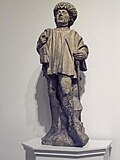 Bavo of GhentVenerable · Missionary in FlandersOct 1
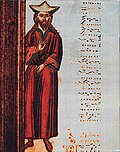 John KoukouzelesVenerable · Composer and reformer of chantOct 1
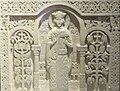 Nana of IberiaEqual-to-the-Apostles · Queen of IberiaOct 1
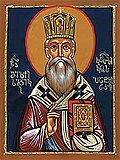 Melchizedek I of GeorgiaSaint · Catholicos-Patriarch of GeorgiaOct 1
 Savva of VisheraVenerable · Founder of Savvo-Vishersky MonasteryOct 1
 Gabriel Bănulescu-BodoniSaint · Metropolitan of ChișinăuOct 1
- Alexis StavrovskyHieromartyr · PriestOct 1
- SidoniaSaintOct 1
- AbaiMartyrOct 1