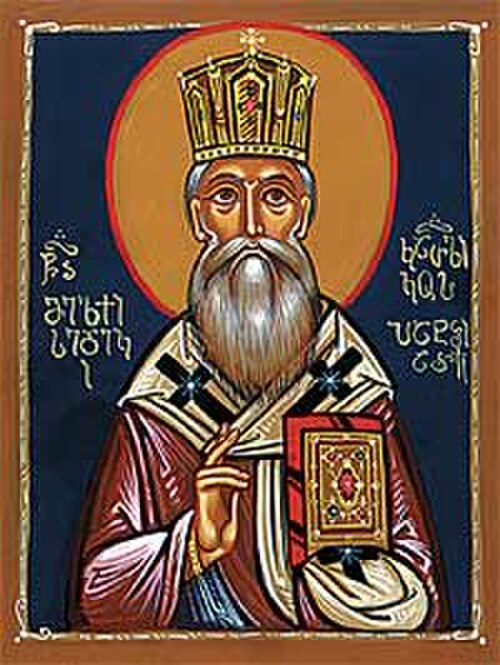
Saint
Melchizedek I of Georgia
Catholicos-Patriarch of Georgia
First Catholicos-Patriarch of All Georgia, serving from about 1010 to 1033, based at Ani.
Life
Saint Melchizedek I was the first Catholicos-Patriarch of all Georgia, in office from about 1010 to 1033 (he died in 1033). The Church of Georgia glorified him on 17 October 2002. The sources give his commemoration as 1 October, while our calendar shows it as 14 October, and the two dates do not agree.
Before him, the heads of the Church of Georgia bore only the title of Catholicos of Kartli. The unification of Georgia into a single kingdom under Bagrat III (975 to 1014) led to the change of title to Catholicos-Patriarch. Melchizedek is traditionally regarded as the first Georgian hierarch to bear it. Our record says that he had his seat at Ani.
After the repose of Catholicos Simeon, Melchizedek took the leadership of the Church of Georgia and shepherded it during the reigns of Bagrat III, George I and Bagrat IV. According to historical sources he was of noble origin and was educated at the royal court, possibly as a pupil of King Bagrat III. His close association with the monarchy strengthened the position of the Church in the unified Georgian state.
One of the most significant works of his tenure was the restoration and adornment of Svetitskhoveli Cathedral in Mtskheta. To support it, he made several journeys to Constantinople, where he met the Byzantine emperor Basil II. He returned with substantial gifts and resources, which enabled the cathedral to be adorned with gold, silver, pearls and precious stones. It is believed that during one of his visits to Byzantium the eastern patriarchs recognized the title "Catholicos-Patriarch" as the official designation of the head of the Georgian Apostolic Orthodox Church. The title is also attested in Melchizedek's surviving testament.
In 1031 he successfully petitioned Bagrat to grant the Church tax immunity, which shows the considerable power of the Church in the state. Our sources say "Bagrat III", but he had died in 1014, so it must have been Bagrat IV. His will lists his gifts of churches, monasteries, villages and sacred objects to Svetitskhoveli Cathedral and specifies the place of burial he desired.
Commemorated the same day October 1
 Romanos the MelodistVenerable · The HymnographerOct 1
 Ananias of DamascusApostle · Apostle of the SeventyOct 1
 Mirian III of IberiaEqual-to-the-Apostles · King of IberiaOct 1
 Bavo of GhentVenerable · Missionary in FlandersOct 1
 John KoukouzelesVenerable · Composer and reformer of chantOct 1
 Nana of IberiaEqual-to-the-Apostles · Queen of IberiaOct 1
 Savva of VisheraVenerable · Founder of Savvo-Vishersky MonasteryOct 1
 Gabriel Bănulescu-BodoniSaint · Metropolitan of ChișinăuOct 1
 Michael NovoselovNew Martyr · Publicist and spiritual writerOct 1
- Alexis StavrovskyHieromartyr · PriestOct 1
- SidoniaSaintOct 1
- AbaiMartyrOct 1