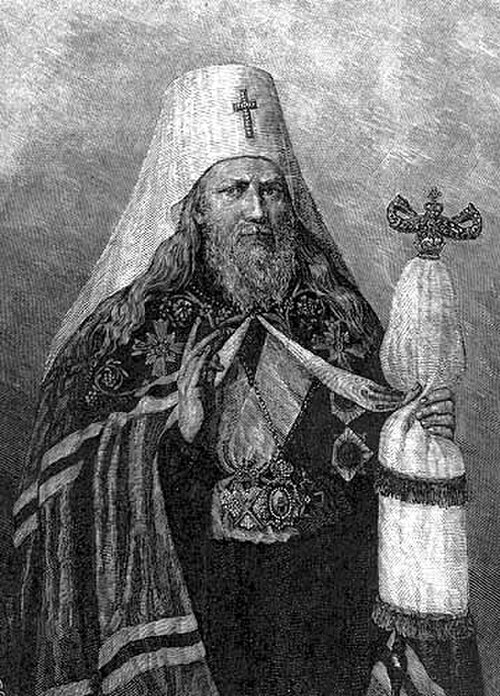
Saint
Gabriel Bănulescu-Bodoni
Metropolitan of Chișinău
Metropolitan of Moldavia, Kherson and Kiev, exarch of Moldo-Wallachia, later archbishop of Chișinău.
Life
Saint Gabriel Bănulescu-Bodoni was one of the great scholars and hierarchs of the Church in the late eighteenth and early nineteenth centuries. Born in Transylvania, he served in turn as Metropolitan of Moldavia, Metropolitan of Ekaterinoslav and Kherson-Tauride, Metropolitan of Kiev and Halych, member of the Holy Synod of the Russian Church, Exarch of Moldavia and Wallachia, and finally as the first chief shepherd of Chișinău and Hotin after the annexation of Bessarabia by the Russian Empire.
The Church honours him above all for organising the church life of Bessarabia, for the seminary and printing press he founded in Chișinău, and for the liturgical books he printed in Romanian. He was numbered among the saints in 2016 and is commemorated on 30 March, the day of his repose.
Origins and schooling
He was born in 1746 in Bistrița, Transylvania, into an old noble family, the son of Grigore and Anastasia Bănulescu-Bodoni; his father's family came from Câmpulung in Moldavia. At baptism he received the name Gregory. He studied first at the school in Bistrița and then at a school elsewhere in Transylvania.
In 1771 he went to the Kiev Theological Academy, where he studied theology for two years. Since services in Moldavia and Wallachia were then often held in Greek, he next went to learn Greek at the schools of Chios, Patmos and Smyrna and at the Athonite Academy of Vatopedi. On Patmos he befriended Nikephoros Theotokis, a learned Greek cleric of the Enlightenment, who would later become his patron.
In 1776 he returned to Transylvania and taught for a short time at Năsăud. From 1777 he was invited to the Princely Academy in Iași, where he taught Latin until 1779.
Monastic tonsure and first ministries
In 1779 he went to Constantinople to perfect his Greek and was received in person by Patriarch Sophronius II. There, in the monastery of the Dormition, he was tonsured a monk with the name Gabriel. He then continued his studies at the school on Patmos, but an epidemic of plague forced him back to Iași, where he took the chair of Greek.
In 1781 he was ordained deacon and then priest by Metropolitan Gabriel Callimachi of Moldavia, brother of the reigning prince Ioan Callimachi. He served as a hieromonk and preacher at the metropolitan cathedral in Iași.
In 1782, at the invitation of Archbishop Nikephoros Theotokis of Slaviansk and Kherson, he moved to Poltava in Russia, where until 1784 he was inspector and teacher of philosophy and Greek at the Slavonic seminary.
Between Moldavia and Russia
In 1784 he returned to Iași and served under Metropolitan Gabriel Callimachi, then was assigned to the diocese of Huși and raised to the rank of archimandrite. He was proposed as Bishop of Roman, but the Phanariot prince of the day rejected the nomination.
When a new Russo-Turkish war broke out, he went to Russia together with the Moldavian prince Alexander Mavrocordatos Firaris and lived at Poltava as the prince's household priest and as a tutor in his family. From 1788 he was rector of the Ekaterinoslav seminary at Poltava, where he formed a true school of Hellenists; among his pupils were I. I. Martynov and N. I. Gnedich, who would later translate the Iliad into Russian.
In 1789, with the Russian armies occupying the Danubian Principalities, he returned to Moldavia and was appointed first member of the spiritual consistory in Iași. The Church in Moldavia was then administered, by order of the Russian Synod, by Archbishop Ambrose Serebrennikov of Ekaterinoslav. On 26 December 1791, in Iași, Ambrose consecrated Gabriel Bishop of Cetatea Albă (Akkerman) and Bender, vicar of the Metropolis of Moldavia.
Metropolitan of Moldavia and the ordeal in Constantinople
Before the Russian withdrawal, in February 1792, by order of Empress Catherine II and the Russian Synod, Gabriel was raised to the rank of Metropolitan of Moldavia and named Exarch of Moldavia, Wallachia and Bessarabia. The Treaty of Iași, however, ended the occupation, and the Principalities returned to the jurisdiction of the Ecumenical Patriarchate.
Patriarch Neophytus VII saw the appointment as a challenge to the authority of Constantinople and asked the new prince, Alexander Mourousis, to remove Gabriel. Gabriel refused to leave his see without an imperial decree. The patriarch then gathered the local bishops, who declared the see vacant and chose another metropolitan, and he obtained from the Sultan an order for Gabriel's arrest. In June 1792 the prince had him seized and taken under guard to Constantinople.
There the Synod of the Patriarchate, presided over by Neophytus VII, deprived him of his see and anathematised him. He was offered a bishopric in Greece but would not give up his Russian allegiance. He was freed through the intervention of the Russian ambassador to the Porte, Viktor Kochubey.
Metropolitan of Ekaterinoslav and of Kiev
In May 1793 he was appointed Metropolitan of Ekaterinoslav and Kherson-Tauride, residing at Poltava. During his tenure, when the empress ordered a city and harbour to be founded on the site of Hadjibey, Gabriel blessed the beginning of the building of Odessa, where the foundations of four churches were laid. It was also he who gave the anointing of the sick to Empress Catherine the Great on her deathbed.
On 29 September 1799 he was transferred to the see of Kiev and Halych and was also a patron of the Kiev-Mohyla Academy. On 7 April 1801 Tsar Alexander I made him a member of the Holy Synod and honoured him with the orders of Saint Andrew the First-Called, Saint Alexander Nevsky and Saint Anne, first class.
Weakened by illness, he asked to retire and was released from the see of Kiev on 21 August 1803, settling in Odessa. In 1805 he moved to Dubăsari, where he lived quietly for several more years.
Exarch of Moldavia and Wallachia
A new Russo-Turkish war again brought Russian armies into the Principalities. On 27 March 1808, by a decree of Tsar Alexander I, Gabriel was once more made a member of the Holy Synod and Exarch of the Church in Moldavia, Wallachia and Bessarabia, residing in Iași, where he was installed on 22 May 1808. He governed the Metropolis of Moldavia until after the Peace of Bucharest of May 1812, caring for the good order of church life and for the printing of books; at Neamț Monastery he printed the Kyriakodromion in 1811.
First chief shepherd of Chișinău
Under the Peace of Bucharest, Bessarabia remained part of the Russian Empire, and Gabriel moved to Chișinău with the task of organising its church life. At his proposal, Tsar Alexander I issued on 21 August 1813 the decree creating the Archdiocese of Chișinău and Hotin, which covered Bessarabia and the Kherson province, including the cities of Odessa, Tiraspol, Ananiev and Elisavetgrad. The tsar allowed the new diocese to order itself according to local custom, and Gabriel was placed at its head, keeping the title of metropolitan.
That same year he opened a theological seminary in Chișinău, teaching in Romanian, and in 1814 he founded the diocesan printing press. From it came, in Romanian, the Primer (1814), the Liturgicon (1815), the Catechism (1816, after Metropolitan Platon of Moscow), the Horologion (1817), the Psalter (1818), the Euchologion, the General Menaion, the Apostle and the Gospel (1820), and the Typikon (1821). At his urging the New Testament (1817) and the whole Bible (1819) were printed in Romanian at Saint Petersburg.
He guided the life of the parish clergy and monasteries of the diocese, built several churches in Chișinău and elsewhere, began in 1817 the building of the metropolitan church and of the cathedral known as the Sobor, and restored the Dormition church of Căpriana Monastery. In 1818, when Tsar Alexander I first visited Bessarabia, he met the metropolitan. The Bessarabian boyars, led by Gabriel, asked that the province be governed according to the old laws of Moldavia, and in 1818 Bessarabia received an autonomous administration in which Romanian and Russian were used alike.
Repose
Metropolitan Gabriel reposed in Chișinău on 30 March 1821 (11 April in the new calendar). His funeral was held on 1 April, and among those present was the poet Alexander Pushkin, then in exile in Chișinău, who left some mocking verses about the day. He was laid to rest at Căpriana Monastery, in the Dormition church he had restored; the monastery has been under restoration since 2005.
A street in Chișinău near the Nativity Cathedral bears his name; formerly Seminary Street and later Gogol Street, it took the name Bănulescu-Bodoni again after Moldova's independence. In 1996 the Moldovan post office issued a stamp in his memory.
Canonisation
On 28 September 2012 the Synod of the Metropolis of Moldova supported the proposal of Metropolitan Vladimir of Chișinău and All Moldova to glorify him. On 15 July 2016 the Holy Synod of the Russian Orthodox Church numbered him among the saints for local veneration in Moldova, a decision confirmed on 28 July 2016 by the Synod of the Orthodox Church of Moldova together with that concerning Blessed Agafia of Cușelăuca Monastery.
His glorification took place on 3 September 2016, a date tied to the founding of the diocese he had shepherded, at Căpriana Monastery where he rests, during a service led by Metropolitan Vladimir at which the act of canonisation was read. The Church calls him Saint Gabriel the Hierarch, Metropolitan of Chișinău and Hotin, and keeps his feast on 30 March.
Commemorated the same day October 1
 Romanos the MelodistVenerable · The HymnographerOct 1
 Ananias of DamascusApostle · Apostle of the SeventyOct 1
 Mirian III of IberiaEqual-to-the-Apostles · King of IberiaOct 1
 Bavo of GhentVenerable · Missionary in FlandersOct 1
 John KoukouzelesVenerable · Composer and reformer of chantOct 1
 Nana of IberiaEqual-to-the-Apostles · Queen of IberiaOct 1
 Melchizedek I of GeorgiaSaint · Catholicos-Patriarch of GeorgiaOct 1
 Savva of VisheraVenerable · Founder of Savvo-Vishersky MonasteryOct 1
 Michael NovoselovNew Martyr · Publicist and spiritual writerOct 1
- Alexis StavrovskyHieromartyr · PriestOct 1
- SidoniaSaintOct 1
- AbaiMartyrOct 1