Venerable
Romanos the Melodist
The Hymnographer
Byzantine hymnographer and composer of the sixth century, author of many kontakia.
- Feast
- October 1old style October 14
- Reposed
- 5566th century
- Place
- Constantinople
- Order
- Venerables
Life
Saint Romanos the Melodist, also called the Hymnographer, was one of the greatest poets of the Church in the sixth century and the first great composer of kontakia. He has been called “the Pindar of rhythmic poetry”. The Orthodox Church keeps his feast on 1 October and honours him as patron of church music.
Life
Most of what we know of him comes from the Menaion for October, compiled after the iconoclast age. Besides the Menaion, his name appears only in Saint Germanus of Constantinople in the eighth century and in the Suda lexicon. According to these sources, he was born in the late fifth century in Emesa (modern Homs) in Syria, or perhaps in Damascus, to a Jewish family. He was baptized as a child; whether his parents also became Christians is uncertain. He moved to Berytus (Beirut), where he was ordained deacon in the Church of the Resurrection.
In the reign of the emperor Anastasius, most likely Anastasius I (491-518), he came to Constantinople and served at the Church of the Mother of God in the Kyros quarter, living in prayer and ascetic labour. The Patriarch loved him for his humility. He died in the second half of the sixth century (some say around 556, others between 562 and 565) and was buried in the church of Kyros together with his disciple Ananias.
The gift from the Mother of God
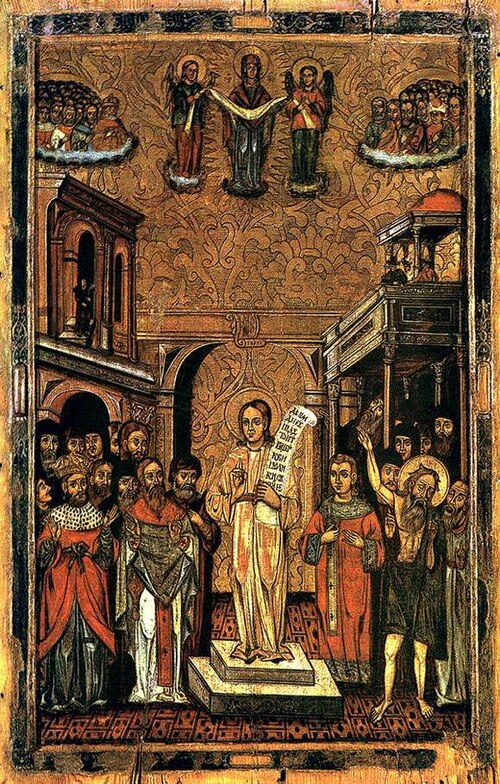
According to tradition, Romanos was at first thought a poor reader and singer. Once, on the night of the vigil for the Nativity of Christ, around the year 518, he was assigned to read the verses of a psalm, but he read so badly that another reader had to take his place. Some lesser clergy mocked him, and he, humiliated, fell asleep, worn out with sorrow.
In his sleep the Mother of God appeared to him holding a scroll and told him to eat it. He woke, received the Patriarch’s blessing, went up into the ambo and sang, unprepared, the famous Kontakion of the Nativity: “Today the Virgin gives birth to Him who is above all being.” The emperor, the patriarch and all the people were amazed at the depth of its theology and at the clearness of his voice. According to tradition this was the very first kontakion ever sung. The scroll he swallowed shows that his gift came from God.
His work
The Synaxarion of Constantinople says he composed more than a thousand hymns. Of the surviving manuscripts, eighty-nine works are attributed to him, and nearly sixty are widely accepted as genuine. A kontakion was a sung sermon in verse of 18 to 30 stanzas called ikoi, with a common refrain and linked by an acrostic; in today’s services usually only the first stanza is sung. Romanos wrote in a literary yet popular Greek. His style has vivid imagery, bold comparisons and much drama, and many of his hymns are cast as dialogues, such as the exchange between the Mother of God and the angels. Until the twelfth century the Kontakion of the Nativity was sung every year at the imperial banquet on the feast, by the joint choirs of Hagia Sophia and the Church of the Holy Apostles.
Veneration
The Orthodox Church commemorates him on 1 October; the Serbian Church and churches on the old calendar keep 14 October. Even the Armenian Church, which did not accept the Council of Chalcedon, commemorates him, and his music influenced Armenian hymnography. In Montenegro, on Mount Sutorman, a church dedicated to him was built, and the first Liturgy was served there in 2019.
Commemorated the same day October 1
 Ananias of DamascusApostle · Apostle of the SeventyOct 1
 Mirian III of IberiaEqual-to-the-Apostles · King of IberiaOct 1
 Bavo of GhentVenerable · Missionary in FlandersOct 1
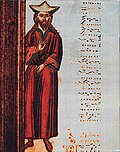 John KoukouzelesVenerable · Composer and reformer of chantOct 1
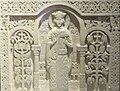 Nana of IberiaEqual-to-the-Apostles · Queen of IberiaOct 1
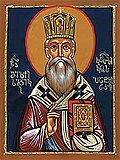 Melchizedek I of GeorgiaSaint · Catholicos-Patriarch of GeorgiaOct 1
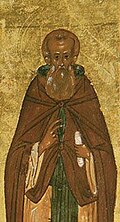 Savva of VisheraVenerable · Founder of Savvo-Vishersky MonasteryOct 1
 Gabriel Bănulescu-BodoniSaint · Metropolitan of ChișinăuOct 1
 Michael NovoselovNew Martyr · Publicist and spiritual writerOct 1
- Alexis StavrovskyHieromartyr · PriestOct 1
- SidoniaSaintOct 1
- AbaiMartyrOct 1