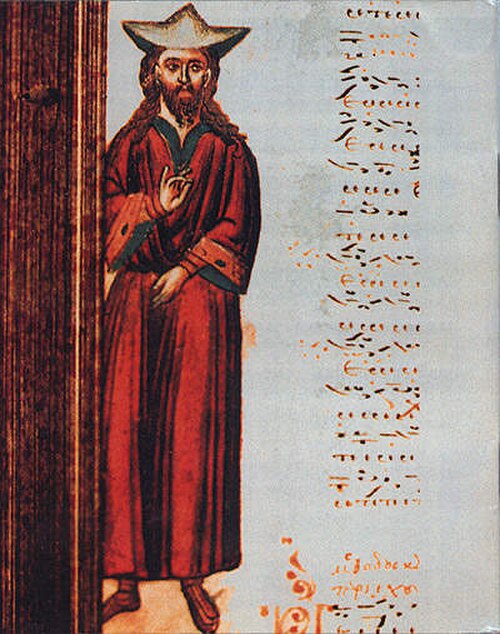
Venerable
John Koukouzeles
Composer and reformer of chant
Byzantine composer and singer, reformer of church chant, who died around 1360 on Mount Athos.
- Feast
- October 1old style October 14
- Reposed
- 136014th century
- Place
- Mount Athos
- Order
- Venerables
Life
Venerable John Koukouzeles was a Byzantine composer and chanter of the thirteenth and fourteenth centuries, a reformer of church chant. He lived as a monk on Mount Athos and died about 1360. He is venerated as a saint and commemorated on 1 October. His music is prized by Albanians, Bulgarians, Greeks, Macedonians, Romanians and Serbs.
His name The name Koukouzeles was not his surname, which was Papadopoulos, that is, son of a priest. Popular tradition says it came from the answer he is supposed to have given, as a poor schoolboy, when asked what he ate: broad beans and cabbage (koukia kai zelie). Scholars consider this a folk etymology, and believe the name comes from a Greek word, koukoutzi, with the suffix elis. He was also called the Angel-voiced, and Kallikeladon, after the beauty of his voice.
Life Little is known of his life and opinions are divided. The sources are his musical manuscripts and a late, anonymous Life of dubious authority. The musicologist Gregorios Stathis thinks he lived in the late thirteenth and early fourteenth century. From the manuscripts it is learned that he studied with Xenos Koronis and had John Glykys as his teacher of chant, and that at his tonsure he received the name Ioannikios.
According to the Life, he was born about 1280 at Dyrrhachium (Durrës, in modern Albania), in a poor family, to a father of unknown origin and a Bulgarian mother. He was orphaned early. With his extraordinary voice he was taken to Constantinople, to the school of the imperial court, where he was educated and became one of the most famous singers of his time, a principal chanter and a favourite of the emperor.
The account of the Life says that the emperor wanted to marry him to the daughter of a great official. John went to his homeland to ask his mother's consent for the wedding. He arranged with friends to tell her that he had died and, hidden in the house, listened to her weeping for him and composed a lament, known as the Polyeleos of the Bulgarian woman. Then he left in secret for Athos, dressed in hair garments, without giving his name. At the gate of the Great Lavra, asked who he was, he said that he was a village shepherd who wished to become a monk. The porter remarked that he was too young, and John answered with the word of the prophet Jeremiah: It is good for a man that he bear the yoke in his youth. This is a story, not secure history. A Russian source says that he lived at the monastery of Saint Athanasius, while others speak of the Great Lavra.
At the Lavra he was tonsured and made shepherd of the monastery's goats. It is told that when he took them out to graze, the goats came back in the evening almost hungry, unlike the days when other fathers tended them. A monk sent to see what was happening said that, as they grazed, Koukouzeles began to sing, and the animals stopped eating and listened. Then the abbot called him and recognised him.
His work Koukouzeles created a new melodic style, called kalophonic, out of the sticherarion, and perfected Byzantine musical notation, the so-called Koukouzelian neumes. About ninety compositions of his are known. The most famous is the Polyeleos of the Bulgarian woman. Many works are attributed to him, but their author is often in fact a school of followers and imitators. His chants, in the transcription of Chourmouzios Chartophylax, are very long and so are rarely sung today, apart from the short Sunday communion hymn.
Veneration John built a cell and a church of the holy Archangels at the place where he struggled and was buried there. On Athos there is preserved the icon before which he prayed earnestly and before which the Mother of God is said to have appeared to him, called after him the Panagia Koukouzelissa. The Church commemorates him on 1 October.
Commemorated the same day October 1
 Romanos the MelodistVenerable · The HymnographerOct 1
 Ananias of DamascusApostle · Apostle of the SeventyOct 1
 Mirian III of IberiaEqual-to-the-Apostles · King of IberiaOct 1
 Bavo of GhentVenerable · Missionary in FlandersOct 1
 Nana of IberiaEqual-to-the-Apostles · Queen of IberiaOct 1
 Melchizedek I of GeorgiaSaint · Catholicos-Patriarch of GeorgiaOct 1
 Savva of VisheraVenerable · Founder of Savvo-Vishersky MonasteryOct 1
 Gabriel Bănulescu-BodoniSaint · Metropolitan of ChișinăuOct 1
 Michael NovoselovNew Martyr · Publicist and spiritual writerOct 1
- Alexis StavrovskyHieromartyr · PriestOct 1
- SidoniaSaintOct 1
- AbaiMartyrOct 1