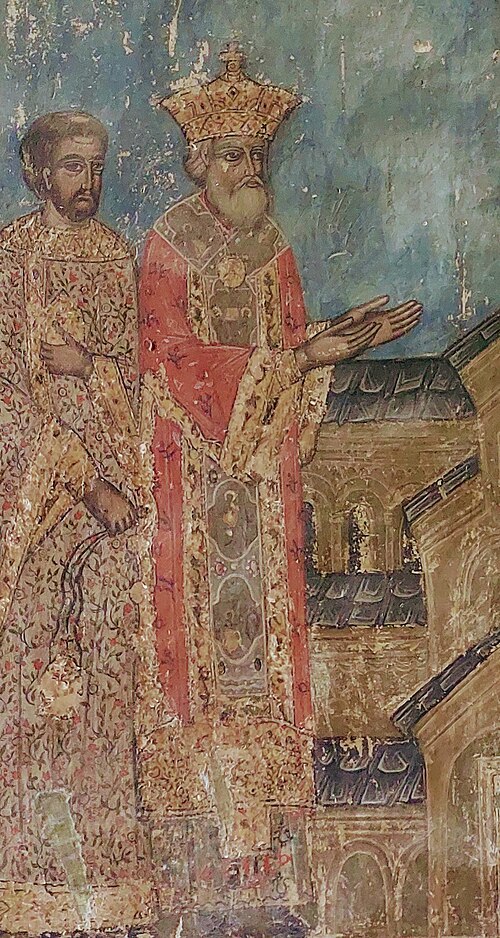
Equal-to-the-Apostles
Mirian III of Iberia
King of Iberia
King of Iberia, in present-day Georgia, contemporary of Constantine the Great and enlightened by St. Nino.
- Feast
- October 1old style October 14
- Reposed
- 3614th century
- Place
- Mtskheta
Life
Mirian III was king of Iberia, that is, of Kartli, in present-day Georgia, a contemporary of the emperor Constantine the Great, and founder of the Chosroid dynasty. According to the Georgian annals and lives of the early Middle Ages, he was the first Christian king of Iberia, brought to the faith through the work of Saint Nino, and made Christianity the state religion. The Georgian Orthodox Church honours him as a saint equal to the apostles, together with his wife, Queen Nana.
Beginnings
Mirian was of the house of Mihran, one of the seven great families of Iran, based at Ray, in northern Iran, which traced its ancestry to the Arsacids. He was born in Iran, probably around 265, and at first was a Zoroastrian. His name is the Georgian form of the Iranian name Mihran; in Greek it was written Mithranes, and the Roman historian Ammianus Marcellinus calls him Meribanes. In 284 the king of kings Bahram II of Persia secured the throne of Iberia for him, to strengthen Persian authority in the Caucasus and command the mountain passes from Mtskheta; according to the chronicle, he sent one of his grandees, Mirvanoz, as Mirian’s guardian, who was only seven. After Mirian’s marriage to Abeshura, daughter of the previous king, many Persian horsemen were stationed in Iberia. The chronicle of Leonti Mroveli, the Life of the Kings, relates his reign in detail, but some of its information is not reliable.
Towards Rome
As a Persian vassal Mirian took part in the brief war of Narseh against the Romans, between 297 and 298; the war ended in a heavy Persian defeat, and Narseh had to cede Armenia and Iberia to the Romans. Mirian quickly adapted to the new state of affairs and formed close ties with Rome. The tie was strengthened by his passing to Christianity. Even afterwards, Constantius, successor of Constantine, had to send in 360 envoys with costly gifts to the king of Armenia and to Meribanes of Iberia, to keep their allegiance to Rome in the struggle with Iran.
Conversion to Christianity
In his reign Christianity was spreading quickly in Transcaucasia and Asia Minor. His wife, Queen Nana, received baptism in 314 from Saint Nino of Cappadocia, and the number of Christians in the land grew. In this situation Mirian used the occasion to break ties with Iran and weaken the wealthy class of pagan priests. According to the legend, while the king was hunting in the environs of Mtskheta, a deep darkness fell over the land and the king could see nothing. In despair he asked for the help of “Nino’s God”. When he had ended his prayer, light returned and Mirian could return to Mtskheta. On his return he met Nino and soon afterwards was baptized. Scholars think that the conversion and the adoption of Christianity as state religion took place in 319 or 337; tradition also gives the year 327. On Saint Nino’s counsel, the king sent an envoy to the emperor Constantine the Great, asking for bishops and priests for Iberia. Constantine fulfilled the request and gave also a place in Jerusalem for the building of a Georgian monastery. Mirian built at Mtskheta a cathedral, on whose site stands today the patriarchal cathedral of Svetitskhoveli; the monastery of Samtavro is also linked with his name.
His end
According to the Georgian chronicle, his reign lasted seventy-seven years, between 268 and 345; Professor Cyril Toumanoff places it between 284 and 361. He died in 361, by this reckoning. He is honoured as founder of Christian Georgia.
Commemorated the same day October 1
 Romanos the MelodistVenerable · The HymnographerOct 1
 Ananias of DamascusApostle · Apostle of the SeventyOct 1
 Bavo of GhentVenerable · Missionary in FlandersOct 1
 John KoukouzelesVenerable · Composer and reformer of chantOct 1
 Nana of IberiaEqual-to-the-Apostles · Queen of IberiaOct 1
 Melchizedek I of GeorgiaSaint · Catholicos-Patriarch of GeorgiaOct 1
 Savva of VisheraVenerable · Founder of Savvo-Vishersky MonasteryOct 1
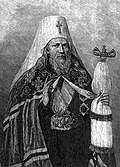 Gabriel Bănulescu-BodoniSaint · Metropolitan of ChișinăuOct 1
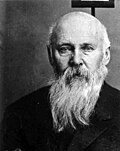 Michael NovoselovNew Martyr · Publicist and spiritual writerOct 1
- Alexis StavrovskyHieromartyr · PriestOct 1
- SidoniaSaintOct 1
- AbaiMartyrOct 1