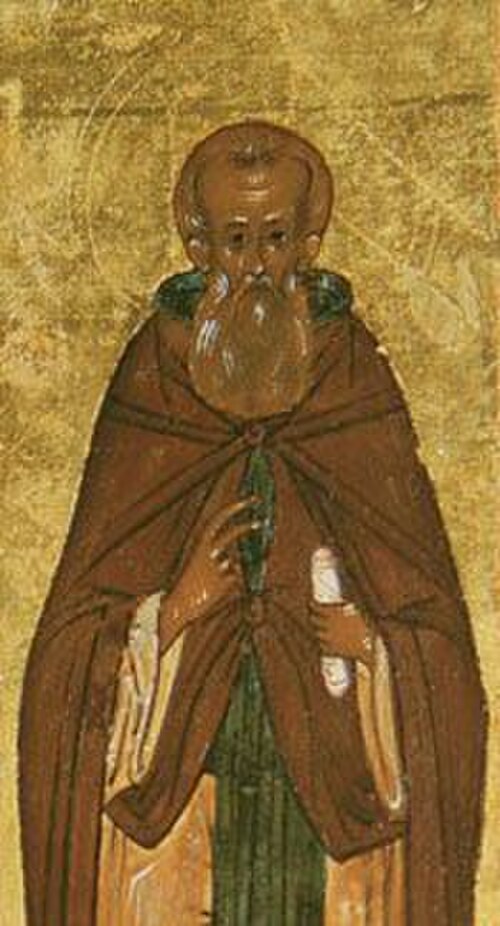
Venerable
Savva of Vishera
Founder of Savvo-Vishersky Monastery
Founder of Savvo-Vishersky Monastery, born at Kashin, known for his labor as a stylite; died in 1460.
- Feast
- October 1old style October 14
- Reposed
- 146015th century
- Place
- Kashin
- Order
- Venerables
Life
Venerable Savva of Vishera was the founder of the Savvo-Vishersky monastery, known for the labour of the stylite, born at Kashin and died, according to tradition, on 1 October 1460. He was canonized at the second Council of Makariev in 1549, for veneration throughout the Church. He is commemorated on 1 October (old calendar). The sources do not agree on the year of death: after Klyuchevsky 1460, but by more recent data, in the 1420s, at the age of 79.
According to his life, Savva was born in the city of Kashin, of a noble family of Tver boyars. On this basis V. O. Klyuchevsky identified him with a Tver boyar, Savva Ivanovich Borozdin, which present research does not confirm. Joseph of Volokolamsk says that Savva Borozdin founded the Savvin monastery of Tver, 20 versts from the city, then went to Athos, but nowhere writes that he returned from Athos and founded a monastery on the Vishera. According to the Serbian source, the monks of the Savino hermitage, where he had settled, chose him abbot; fleeing from glory, he went to the Holy Mountain and, after three years, returned to Novgorod and lived there as an unknown pilgrim.
After his monastic tonsure, Savva laboured long in the monasteries of Tver, then settled on the river Vishera, in the environs of Novgorod. The townspeople learned of the hermit's dwelling, and he, seeking solitude, moved to the river Sosnitsa. There Archbishop John of Novgorod visited him and provided all that was needed for building a hermitage. But because of a land dispute with the Lisitsky monastery, he left the river Sosnitsa and returned to the Vishera, where the Slavensky End of Novgorod granted him a place for building a monastery. In 1418, with the blessing of Archbishop Simeon, Savva built a wooden church in honour of the Ascension of the Lord and cells for the brethren. After that Savva set up a pillar for himself, on which he spent the whole week, descending only on Saturdays, to be with the brethren at the Sunday service and receive Communion. A detail of the Serbian source says that he spent the greater part of his life labouring on the pillar.
His relics were buried between the church he built and the pillar, and a chapel was raised over the grave. Later a fire destroyed the buildings, but, according to tradition, the venerable one's coffin remained unharmed, which began his veneration. Abbot Gelasius compiled short notes on Savva's life and, on their basis, in 1464, by order of Archbishop Jonas, Pachomius Logothetes wrote the life and service of the venerable one.
Commemorated the same day October 1
 Romanos the MelodistVenerable · The HymnographerOct 1
 Ananias of DamascusApostle · Apostle of the SeventyOct 1
 Mirian III of IberiaEqual-to-the-Apostles · King of IberiaOct 1
 Bavo of GhentVenerable · Missionary in FlandersOct 1
 John KoukouzelesVenerable · Composer and reformer of chantOct 1
 Nana of IberiaEqual-to-the-Apostles · Queen of IberiaOct 1
 Melchizedek I of GeorgiaSaint · Catholicos-Patriarch of GeorgiaOct 1
 Gabriel Bănulescu-BodoniSaint · Metropolitan of ChișinăuOct 1
 Michael NovoselovNew Martyr · Publicist and spiritual writerOct 1
- Alexis StavrovskyHieromartyr · PriestOct 1
- SidoniaSaintOct 1
- AbaiMartyrOct 1