Saint
Hyacinth of Vicina
First Metropolitan of Ungro-Wallachia
Greek hierarch, last Metropolitan of Vicina and first of Ungro-Wallachia; he died in 1372.
- Feast
- October 28old style November 10
- Reposed
- 137214th century
- Order
- Hierarchs
Life
Holy Hierarch Hyacinth of Vicina was a Greek Orthodox hierarch of the fourteenth century (born probably toward the end of the thirteenth century), the last metropolitan of Vicina and the first metropolitan of Ungro-Wallachia, that is of Wallachia. He died at Curtea de Argeș in 1372. The Romanian Orthodox Church numbered him among the saints on 26 October 2008 and remembers him on 28 October.
Metropolitan of Vicina and of Wallachia
At that time, for the Daco-Roman people, the language of the service was Slavonic north of the Danube and ecclesiastical Greek in Dobruja. The Romanian lands north of the Lower Danube, inhabited by Daco-Romans and subject to the Hungarian kingdom until the battle of Posada (1330), were called by the Byzantine chanceries Ungro-Wallachia and were shepherded by the Patriarchate of Constantinople through chorepiscopi (itinerant bishops) sent by the perichoretes of Vicina. When the principalities between the Carpathians and the Danube united in the voivodeship of Wallachia, Bishop Hyacinth of Vicina, one of the perichoretes, became the first metropolitan of Ungro-Wallachia.
Hyacinth followed at Vicina Metropolitan Cyril, who held the see between 1347 and 1348. He was not long perichoretes at the exarchate of Vicina, for from 1359 he moved to Curtea de Argeș. At the Synod of Constantinople, Patriarch Callistus I decided that the perichoretes of Vicina should be spiritual shepherd of all the Romanians of Dobruja and Wallachia. The diocese of Vicina was abolished and a new Romanian metropolis came into being, called the Metropolis of Ungro-Wallachia, and Hyacinth was thus the first metropolitan of Wallachia.
His work
As perichoretes, but above all as metropolitan, Hyacinth ordained many priests, had numerous churches built in towns and villages, and kept the spiritual and canonical tie between the Church of Wallachia and the Patriarchate of Constantinople. Helped by Prince Vladislav I Vlaicu, he founded new monastic settlements (among them Tismana, Curtea de Argeș, Câmpulung, Cozia, Snagov, Târgoviște, Bolintin, Tânganu and Cotmeana). He also cared for the Orthodox in neighbouring lands, such as Transylvania, where he sent chorepiscopi, priests and monks. He also brought to Wallachia the monk Nicodemus from Mount Athos, to arrange several monastery-lavras on the Athonite model, and in the other direction sent many "Vlach" monks to the Koutloumousiou monastery on Mount Athos, where some became renowned.
Last years and veneration
His last years were burdened by illness and by envious colleagues, who prevented him from taking part in the Patriarchal Synod of 1370, of which he was a member by right. In a letter to the patriarch of Constantinople, Hyacinth wrote that a great weakness had seized him and that he was hurt in his very old age, and asked him not to overlook his old age and the severity of his illness and that the patriarch's prayers be his shield for ever. He died at Curtea de Argeș in 1372, after, says the church hagiography, he "shepherded with zeal, counselled with wisdom and suffered with patience and humility". From 26 October 2008 the Romanian Orthodox Church counts him a holy hierarch and celebrates him on 28 October, as shepherd and spiritual father of all Romanians between the Danube and the Carpathians.
Commemorated the same day October 28
 Abgar of EdessaRight-Believing · King of EdessaOct 28
 Arsenije of SerbiaSaint · Archbishop of SerbiaOct 28
 Arsenios the CappadocianVenerable · Spiritual father from CappadociaOct 28
 Job of PochaevVenerable · Abbot of PochaevOct 28
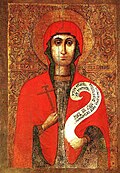 Paraskevi of IconiumGreat Martyr · Great Martyr, called FridayOct 28
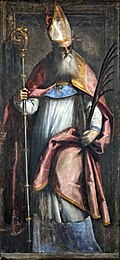 Judas CyriacusSaint · Bishop of JerusalemOct 28
- Arsenius AutorianusSaint · Patriarch of ConstantinopleOct 28
- FirmilianSaint · Bishop of Caesarea in CappadociaOct 28
 Stephen the SabaiteVenerable · Hymnographer of Mar SabaOct 28
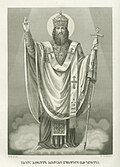 Neophytus of UrbnisiSaint · Bishop of UrbnisiOct 28
 Terence and NeonillaMartyrOct 28
- Theodora of WallachiaSaint · Tsaritsa of BulgariaOct 28