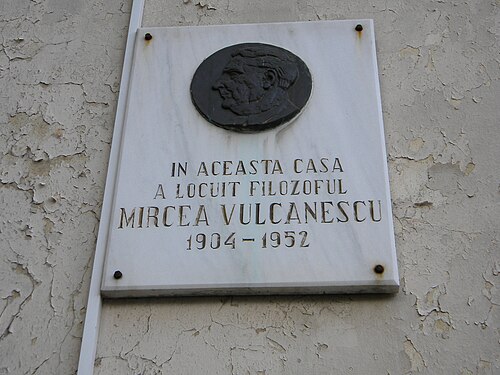
Confessor
Mircea Vulcanescu
A philosopher and economist who died in Aiud prison in 1952; venerated by the faithful as a martyr, not formally canonized.
- Feast
- October 28old style November 10
- Reposed
- 195220th century
- Place
- Aiud prison, Alba County
- Order
- Confessors
Life
Mircea Vulcănescu was born on 3 March 1904 in Bucharest and died on 28 October 1952 in Aiud prison, aged forty-eight. He was a philosopher, sociologist, economist and professor, a disciple of Dimitrie Gusti and Nae Ionescu, and an undersecretary of state at the Ministry of Finance in the government of Ion Antonescu, between 1941 and 1944. He is venerated by some believers as a confessor of the prisons, without synodal canonization; his role in the Antonescu government is discussed by historians.
He completed Philosophy and Law at Bucharest, in 1925, studied in Paris and wrote essays of philosophy, sociology and economics, among them The Romanian Dimension of Existence (1943). He took part in the monographic campaigns of Gusti's school and contributed to Gândirea, Criterion and Cuvântul. Between 1935 and 1937 he was director general of Customs, then director of the Public Debt. Between January 1941 and August 1944 he was undersecretary of state at Finance and negotiated for Romania with Germany. In the war years he also frequented the Burning Bush prayer circle at Antim Monastery.
After 23 August 1944 he remained in his post as head of the Public Debt until August 1946, when he was arrested in the second group of former members of the Antonescu government. On 9 October 1946 he was sentenced to eight years of hard imprisonment, as guilty of war crimes; the appeal of 1948 was rejected. The Elie Wiesel Institute considers him the initiator of several anti-Jewish legal acts, while his defenders maintain that he acted for the financial interests of the state and was unjustly judged.
At Aiud he gave the prisoners lectures that strengthened their morale. According to witnesses, one winter he was shut in a cell in the citadel, in the frost. He died on 28 October 1952, ill in the lungs. He is said to have left the exhortation: Do not avenge us.
His veneration is upheld by the writings of former prisoners and by many believers and contested by others, in light of his political role. He has no synodal canonization.
Commemorated the same day October 28
 Abgar of EdessaRight-Believing · King of EdessaOct 28
 Arsenije of SerbiaSaint · Archbishop of SerbiaOct 28
 Arsenios the CappadocianVenerable · Spiritual father from CappadociaOct 28
 Job of PochaevVenerable · Abbot of PochaevOct 28
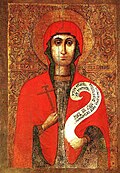 Paraskevi of IconiumGreat Martyr · Great Martyr, called FridayOct 28
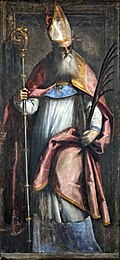 Judas CyriacusSaint · Bishop of JerusalemOct 28
- Arsenius AutorianusSaint · Patriarch of ConstantinopleOct 28
- FirmilianSaint · Bishop of Caesarea in CappadociaOct 28
 Stephen the SabaiteVenerable · Hymnographer of Mar SabaOct 28
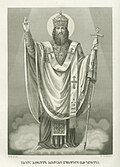 Neophytus of UrbnisiSaint · Bishop of UrbnisiOct 28
 Terence and NeonillaMartyrOct 28
- Theodora of WallachiaSaint · Tsaritsa of BulgariaOct 28